
Use the Terminal sidebar for a quick discussion beside the product. Open AI Lab when a source, backtest, saved study or longer workflow matters.
Product guide / Atlas AI
Ask clearly. Build with evidence. Keep the thread.
A screen-by-screen guide to choosing the Terminal sidebar or full AI Lab, asking direct trading questions, attaching research sources and keeping every empirical number tied to an exact completed result.
2Conversation surfaces
DirectConcept questions need no dataset
ThreadedFollow-ups retain continuity
ExactEmpirical claims need receipts
A conceptual question can be answered directly. A claim about measured performance needs a source, declared assumptions and a completed result.
Keep the conversation for reasoning and the exact run receipt for empirical figures. Start New Chat when the objective or evidence base changes.
Atlas AI / Product tour
Keep the conversation beside the decision.
The Terminal sidebar gives Atlas a small, bounded hint about where you are. It keeps quick questions close to the selected product without turning the visible page into trusted market evidence.
The Atlas sidebar in the Terminal
Open Atlas from the right rail when you want a fast explanation, a product question or a follow-up while keeping the Terminal visible. The screenshot below shows the compact context band, suggested questions, model selector and composer in one place.
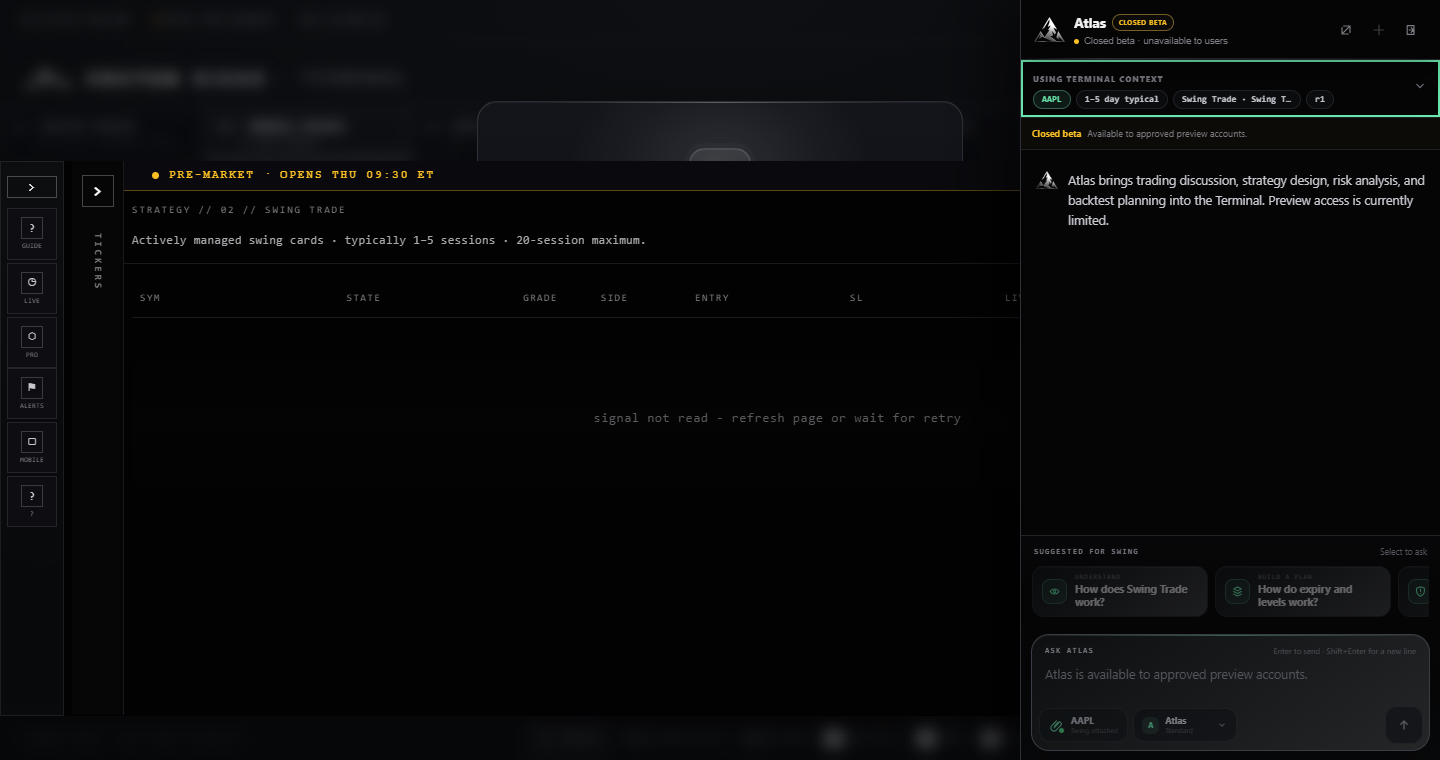
1The sidebar is the quick conversation surface. Use the expand control when the task needs the full AI Lab workspace.
2The context band can identify the current symbol, product or profile. It is a navigation hint, not a verified live record.
3Suggested prompts provide a starting point. Edit them so the requested output, assumptions and evidence standard are explicit.
4The governed selector exposes Atlas and, when your account is entitled, Atlas Pro. A visible locked option does not grant access.
5Write the question in the composer, attach a source when the task is empirical, then send. Follow-ups continue in the same conversation.
The screenshot shows a point-in-time access state. Availability and entitlement labels can change. Your current account state in the live product is authoritative.
Atlas AI / Chapter 01
Choose the smallest workspace that fits the task.
The sidebar and full AI Lab share the conversation-first experience, but they serve different depths of work. Start compact; expand when evidence, tools or saved research become part of the answer.
Terminal sidebar
Best for conceptual questions, product explanations, card-field questions and short follow-ups while the Terminal remains visible.
AI Lab
Best for attaching a source, defining a study, declaring costs and timezone, running deterministic work and returning to saved research.
No dataset required
General trading knowledge can be answered directly. Do not upload data merely to ask what a fair value gap, ATR or trailing stop means.
Evidence required
Measured win rates, returns, drawdowns, sample sizes and strategy comparisons require an exact completed result containing those figures.
Surface selection
| Your task | Start here | What to provide | What Atlas should return |
|---|---|---|---|
| Explain a trading concept | Sidebar or AI Lab | The concept and your preferred depth | A direct educational answer without demanding a dataset |
| Explain the selected Terminal product | Terminal sidebar | The exact field or behavior you do not understand | Product guidance grounded to the selected area, without inventing live values |
| Research an attached market source | Full AI Lab | Source, schema, timezone, costs and objective | A deterministic result plus assumptions and evidence reference |
| Continue a line of reasoning | Same conversation | A focused follow-up | An answer that uses bounded recent history |
| Begin a different study | New Chat | The new objective and evidence base | A separate server thread with no accidental carryover |
Practical rule: if the answer can be correct from standard trading knowledge, ask directly. If the answer contains a measured fact about a market, portfolio or strategy, attach or select the source and require a completed result.
Atlas AI / Chapter 02
Ask conceptual trading questions directly.
Atlas should answer ordinary trading questions from standard knowledge. It should not force Terminal doctrine, a dataset upload or a tool run when the question is educational rather than empirical.
Good direct questions
Define
“What is a fair value gap, and what are the common ways traders misuse it?”
Compare
“Compare a fixed stop with a trailing stop. Explain the trade-offs in volatile openings.”
Teach
“Explain mean reversion to someone who understands candles but not statistical signals.”
Stress-test an idea
“What assumptions could make an opening-range breakout look stronger than it really is?”
Make the requested answer shape explicit
Name the concept or decision
Ask one clear question before adding constraints or examples.
Set the audience
Say beginner, practitioner or technical so the explanation lands at the right depth.
Choose the format
Request a checklist, comparison, worked example, failure modes or concise answer.
Label teaching numbers
Ask Atlas to mark any invented teaching figures as illustrative or hypothetical.
Conceptual is not empirical. Atlas can explain how Sharpe ratio works without a dataset. It cannot state the Sharpe ratio of a strategy without an exact completed result containing that figure.
Atlas AI / Chapter 03
Use one conversation for one line of work.
Atlas conversations maintain a conversation-specific server workspace and bounded recent history. Follow-ups can refine the same task without restating everything; New Chat deliberately isolates a different task.
Continue the thread
Use follow-ups to change the explanation depth, challenge an assumption, refine costs or request a different presentation of the same evidence.
Start New Chat
Use New Chat when the strategy, source or objective changes. It creates a separate conversation rather than contaminating the previous study.
Recent history is bounded
Do not assume every old message remains active forever. Restate the decisive constraint when a long conversation changes direction.
Keep visible work
A transient network, server or usage-accounting failure should not erase the visible conversation. Retry in the same thread unless access has actually been revoked.
A clean multi-turn sequence
Ask the base question
“Explain how a trailing stop behaves during a volatile open.”
Challenge one assumption
“Now assume confirmation only occurs on a completed one-minute close. What changes?”
Request a teaching example
“Show a clearly labelled hypothetical example with entry, high-water mark and next-bar activation.”
Separate a new project
Choose New Chat before switching to an unrelated earnings strategy or a different attached source.
Atlas AI / Chapter 04
Treat Terminal context as a hint, never a receipt.
The Terminal can pass bounded navigation context so Atlas knows which area you are looking at. That helps route the explanation; it does not convert browser labels into trusted live market or performance evidence.
| Context may indicate | It must not be treated as | Where to verify instead |
|---|---|---|
| Selected symbol or profile label | A trusted security master, quote or current company record | The attached source or verified product record |
| Selected Terminal product | Proof that a particular model owns a trade | The current card's native product badge |
| Selected timeframe | Proof of the candles, timezone or bar completion used in a study | The deterministic run input and result |
| Visible state or page label | A trusted current position, live price, stop or alert receipt | The live card and timestamped Alert Log |
| Visible P&L or performance label | A final realized performance claim | The exact expanded Performance receipt |
How to ask about a selected card
Useful prompt: “Explain the selected card's fields and likely workflow. Use the Terminal selection only as a navigation hint. Do not state a live price, position, stop, P&L or performance result unless it is present in a trusted record I attach.”
Use product guidance selectively
Product-specific guidance belongs in the answer only when you ask about a selected Terminal card, signal, setup or Vector Ridge feature.
Keep general answers general
A question about market structure or risk does not need Terminal doctrine added merely because the sidebar is open.
Return to the live surface
Use the current card for present state, the Alert Log for chronology and Performance for the final closed receipt.
Attach evidence when needed
If you want Atlas to calculate or compare, supply the exact data rather than relying on a visible page label.
Atlas AI / Chapter 05
Define the source before asking for a measured answer.
A research task becomes reproducible when Atlas knows exactly what data to use, how time is represented, which costs apply and what output decides success.
The five-part research brief
Attach or select the exact source
Name the file, Data Vault source or saved dataset. Do not say “use market data” when several sources could qualify.
Declare the timezone and bar semantics
Specify ET, UTC or another zone, and whether timestamps represent bar open, bar close or event time.
Declare costs
State commissions, spread, slippage or a simple basis-point assumption. Say explicitly when the study is gross of costs.
Write deterministic rules
Define the entry, exit, sizing, overlap, session and missing-data behavior without discretionary gaps.
Name the required receipt
Ask for the completed result identifier, sample size, period, assumptions and any rejected or unavailable metrics.
Weak request versus reproducible request
| Weak | Reproducible |
|---|---|
| “Backtest an ORB strategy.” | “Use my attached one-minute bars. Interpret timestamps in ET and exclude pre-market bars.” |
| “Use realistic costs.” | “Apply 2 bps per side plus the spread field in the source; report gross and net separately.” |
| “Buy the breakout.” | “Enter on the next completed bar after a close above the first 15-minute high; permit one position per symbol per session.” |
| “Tell me if it works.” | “Return trade count, net return, win rate and max drawdown only if each is present in the completed deterministic result.” |
Do not let defaults hide inside the answer. Timezone, session, costs, overlap and missing-data handling can materially change a result. Make them visible before comparing variants.
Atlas AI / Chapter 06
Separate teaching examples from empirical claims.
Atlas can use simple invented numbers to teach a concept when they are clearly labelled. Real-world performance figures need a server claim contract that points to the exact completed deterministic result containing them.
Illustrative
“Hypothetical example: risk $1 to target $2, a 2:1 reward-to-risk ratio.” The label makes clear that no observed result is being claimed.
Empirical
“The completed result reports 184 trades and a 57.1% win rate.” Both figures must exist in that exact result.
Unsupported
If the completed result does not contain a requested metric, Atlas should withhold it rather than estimate, infer or borrow it from another run.
Claim contract
The answer should preserve the link between each measured figure and the completed deterministic result that produced it.
Evidence checklist
Completed status
Do not treat a preview, queued request or partial tool output as a final empirical result.
Exact result identity
Keep the result reference with the answer so a later follow-up cannot silently switch evidence.
Matching assumptions
Confirm source, period, timezone, costs and rules before comparing numbers across variants.
Metric presence
Every empirical number in the prose must appear in the exact completed result or be withheld.
Useful verification prompt: “For every empirical number in your answer, name the exact completed deterministic result field that contains it. If a requested figure is absent, say unavailable. You may use clearly labelled illustrative numbers only for teaching.”
Atlas AI / Chapter 07
Use the governed model selector as an access boundary.
Atlas and Atlas Pro appear through a governed selector. Atlas Pro remains entitlement-gated; neither a prompt, URL parameter nor visible control should bypass the plan attached to the account.
Standard access
Use Atlas for direct questions, explanations and the workflows available to your account.
Entitled access only
Select Atlas Pro only when the live product confirms that your account is entitled. A locked option is informational, not an invitation to bypass access.
Evidence rules do not change
Pro access never relaxes source, claim-contract or no-invented-metrics requirements.
Preserve the Closed Beta boundary
Preview and beta labels must remain accurate. A guide should explain access, not imply that general user access is enabled.
If Atlas Pro is unavailable, continue with Atlas or review your plan. Do not repeatedly resubmit the same request as a way to probe or circumvent the entitlement gate.
Atlas AI / Chapter 08
Use prompts that make the decision and evidence visible.
The strongest prompt says what you want, what Atlas may trust, which assumptions apply and what the final answer must include or withhold.
Copy, then adapt
Direct conceptual question
“What is a fair value gap? Give me a direct educational explanation, one clearly labelled hypothetical example and three common failure modes. Do not require a dataset or force Terminal-specific doctrine.”
Selected Terminal card
“Explain the selected trade card's fields and lifecycle in plain English. Treat the selected symbol, product and timeframe only as bounded navigation hints. Do not invent or repeat a live price, position, stop, P&L or performance result as trusted evidence.”
Attached-source strategy study
“Use only my attached one-minute source. Interpret timestamps in ET. Define the first 15 completed regular-session minutes as the opening range. Enter on the next completed bar after a close outside the range. Apply 2 bps per side, permit one trade per symbol per session and return only metrics present in the exact completed deterministic result.”
Cost sensitivity
“Using the same completed study and unchanged rules, compare gross results with 1, 2 and 5 bps per side. Keep each result identity separate. Do not combine figures across runs, and state unavailable for any metric not returned.”
Evidence audit
“Audit your previous answer. For each empirical number, name the exact completed deterministic result and field containing it. Remove unsupported figures. Keep clearly labelled illustrative examples separate from measured results.”
Multi-turn refinement
“Keep the same source, timezone, costs and deterministic rules. Change only the exit from end-of-day to a completed-close trailing rule, then explain exactly which assumption changed before running it.”
Start a clean project
“This is a new study with a different source and objective. I am starting it in New Chat so no prior strategy rules or result identities carry over.”
Prompt formula
What should Atlas do?
Explain, compare, design, test, audit or summarize. Use one primary verb.
What may it trust?
Name the attached source or state that the question is conceptual and needs no empirical data.
Which assumptions apply?
Declare timezone, session, costs, entry, exit, sizing, overlap and missing-data behavior.
What must be returned?
Require exact completed result references, available metrics and explicit withholding of unsupported claims.
Atlas AI / Chapter 09
Know what Atlas can answer, infer and verify.
Reliability comes from using standard knowledge for concepts, trusted sources for measurement and the live product for access and current Terminal state.
Trading concepts
Atlas can answer general educational questions directly and can label a teaching example as illustrative.
Terminal selection
Useful for routing a product explanation, but not trusted evidence of a live position, price, stop or result.
Deterministic result
Required for empirical performance numbers and comparisons. Each claim stays attached to the exact completed result.
Live entitlement
The current account and governed model selector decide whether Atlas Pro or preview features are available.
Common questions
Do I need to attach data to ask a trading question?
No. Conceptual trading questions should receive a direct educational answer. Attach or select data when you want a measured claim, strategy result or source-specific analysis.
Does the Terminal sidebar know the current live trade?
It may receive bounded navigation context, but that context is not a trusted live record. Verify current state on the live card, chronology in Alerts and final results in Performance.
When should I choose New Chat?
Start New Chat when the objective, strategy, source or evidence base changes. Keep follow-ups in the current conversation when they refine the same line of work.
Can Atlas use a simple 2:1 example?
Yes, when it is clearly labelled illustrative or hypothetical. It must not present that number as an observed strategy outcome.
What if a result does not contain the metric I asked for?
Atlas should say that the metric is unavailable and withhold the figure. It should not estimate it, borrow it from another result or infer it from prose.
Why can I see Atlas Pro but not select it?
The selector is governed by account entitlement. A visible locked option explains availability but does not grant access.
Ready
Start with the question. Add evidence only when the claim needs it.
Use the Terminal sidebar for quick context, the full AI Lab for reproducible research, New Chat for a clean objective and exact completed results for every empirical number.