
Overnight Trade is designed around a typical 0.5–2 market-session hold. An earlier stop or close event can finish it first.
Trading Terminal / How to use / Overnight Trade
Read the full Overnight lifecycle across the session boundary.
A screen-by-screen guide to preparation, entry, the typical 0.5–2 session horizon, current stops, event risk, newest-first chronology, charts, alerts and the one final record in Performance.
0.5–2 sessionsTypical, never guaranteed
Cross-sessionShort recovery horizon
Current stopLatest value and time
One receiptVerified in Performance
Preparation badges are not positions. Once open, the latest stop and its update time matter more than an older screenshot.
Use the board for now, Alert Log for sequence, chart for context and Performance for the final receipt.
Overnight Trade / Product tour
Orient yourself on the loaded Overnight board.
The selected product, session banner, row state stack, side, entry, current stop, price reference and chart control answer different questions. Read them in that order before reacting to a move.
The real product surface
This account-safe production capture shows Overnight Trade selected with active entry instructions, open positions, warning context and a recent close. The board is not a static watchlist: each row carries one lifecycle whose latest event determines what you should read next.
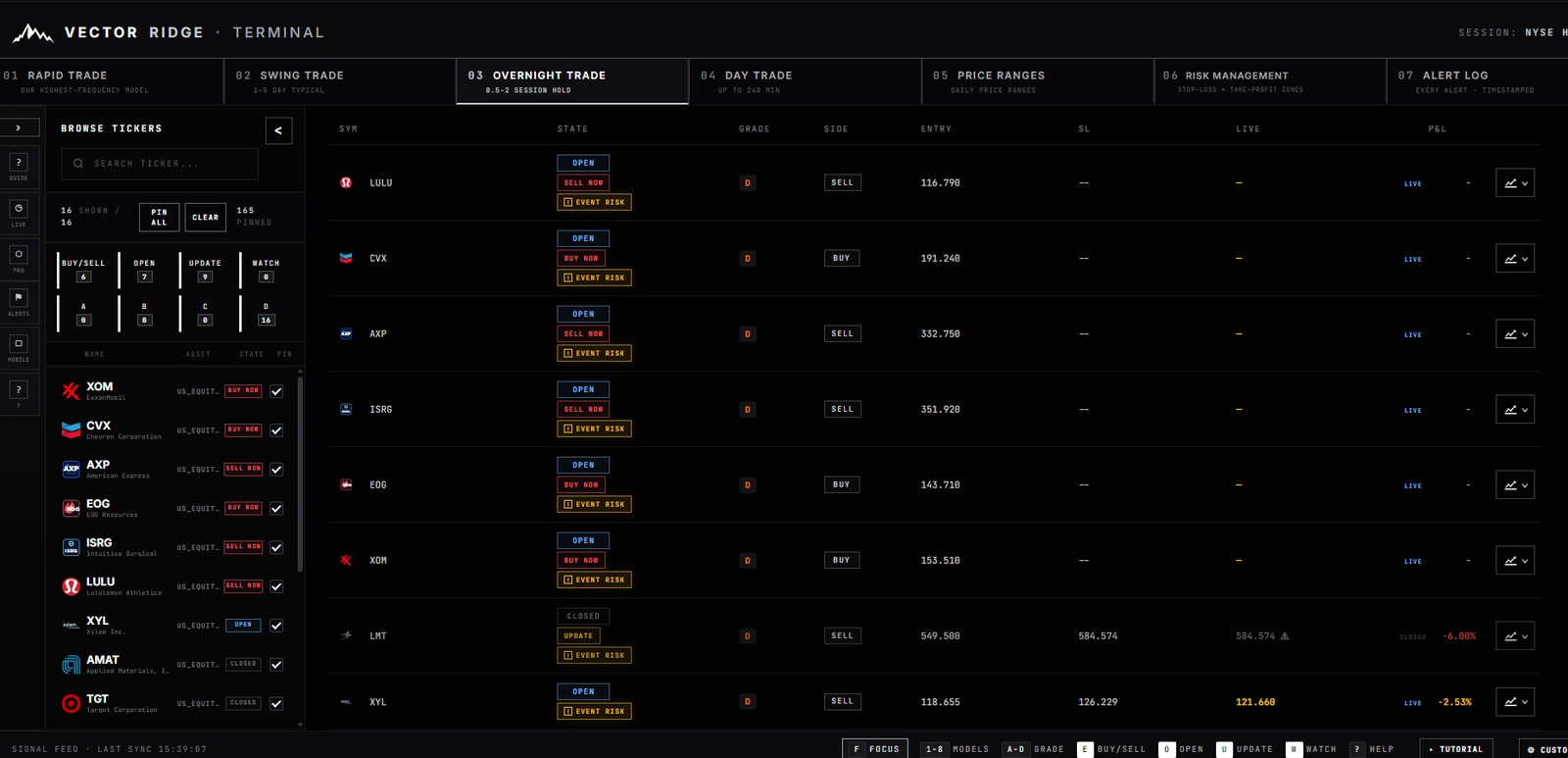
1The selected Overnight tab establishes the native short cross-session product. It is not a generic filter over every Terminal trade.
2The 0.5–2 session label describes the typical product horizon. It is not a promise that every position remains open for that length.
3The ticker browser lets you search and pin records without changing the underlying lifecycle or product ownership.
4Read OPEN, BUY NOW, SELL NOW or CLOSED first. UPDATED and EVENT RISK add context without replacing that primary state.
5The right-edge chart control opens the exact selected trade; it is not a generic ticker chart detached from the record.
Use every screenshot for orientation, not current instructions. Prices, states and timestamps are frozen at capture time. The live Overnight board is the authority for what is active now.
Overnight Trade / Chapter 01
Know what Overnight Trade is built to do.
Overnight Trade is the Terminal's dedicated short-horizon recovery and mean-reversion product. A position may cross a session boundary, but it remains governed by the latest published state and stop.
Short cross-session identity
A native Overnight trade is built to hold through part of one session and, when needed, across the next opening boundary.
Typical horizon
Roughly 0.5–2 market sessions is the product guide, not a fixed or guaranteed duration.
Current stop
SL is the latest published stop. It can change during an open trade, so always pair it with its timestamp.
One result
Whether also visible in Rapid or Alerts, the trade settles as one economic record in Performance.
Overnight is not Swing with a shorter label. Its recovery-oriented horizon, product membership, ordering and public lifecycle are distinct.
Overnight Trade / Chapter 02
Read one complete row from left to right.
The reliable sequence is symbol and product, primary state, context badges, grade, side, entry, current stop, live or closed reference, P&L, then chart.
This focused production crop shows open Overnight rows beside a recent close. The vertical state stack prevents context from crowding the primary state, while the muted closed row remains readable without looking live.
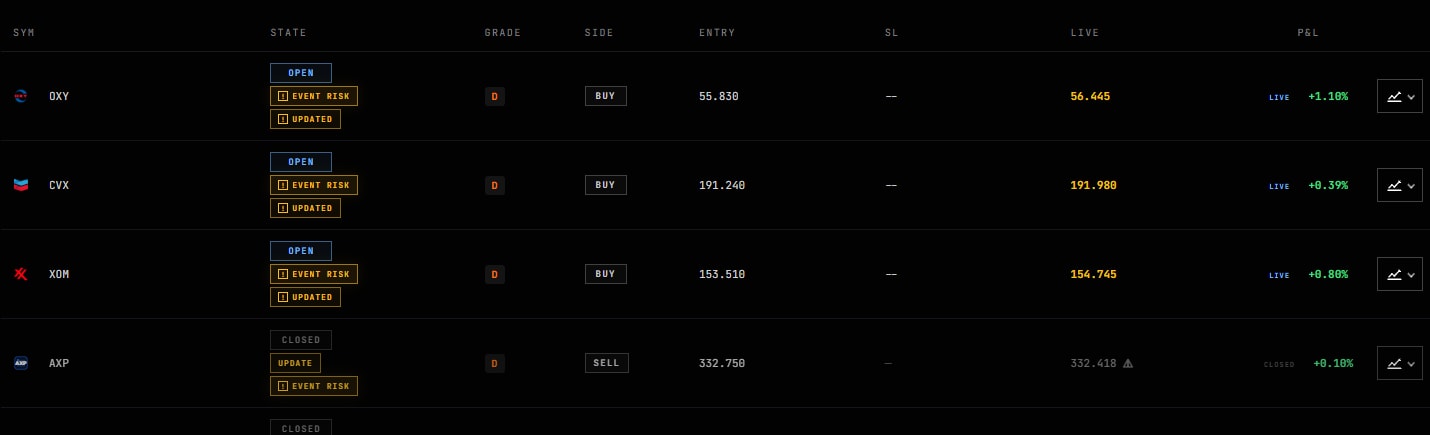
1The symbol identifies the company; the selected Overnight board establishes native product context.
2OPEN or CLOSED is primary. UPDATED and EVENT RISK sit beneath it as context and never make a closed trade active again.
3Grade records conviction at entry; BUY or SELL determines the return direction.
4Entry anchors the recorded trade. The SL column contains the current stop when published; a dash means no current value is shown.
5The muted final mark and CLOSED label distinguish the completed price from a changing live reference.
6Open the chart to reconcile entry, risk changes, close marker and timestamps for this exact row.
Field reference
| Field | What it answers | What not to assume |
|---|---|---|
| OVERNIGHT badge | Does Overnight own this lifecycle? | Visibility in Rapid does not move ownership away from Overnight. |
| State | What is the newest public lifecycle status? | EVENT RISK or UPDATED is context, not a replacement primary state. |
| Grade A–D | What conviction was recorded at entry? | It is not an expected-return forecast and never overrides the current stop. |
| Side | Is the position BUY or SELL? | Do not infer direction from P&L color. |
| Entry | What published price anchors the trade? | ENTRY NEAR is preparation, not a completed entry. |
| SL | What published stop is current? | It is not a fixed lifetime value and is not a target. |
| Live / Closed | What mark is active now, or what close was recorded? | A delayed live reference is not a broker quote. |
| P&L | How is the trade performing relative to its recorded side? | Open P&L is not the final realized result. |
Overnight Trade / Chapter 03
Separate preparation from an active position.
WATCH and ENTRY NEAR help you prepare. BUY NOW or SELL NOW publishes the entry instruction; OPEN confirms an active record; CLOSED ends the lifecycle.
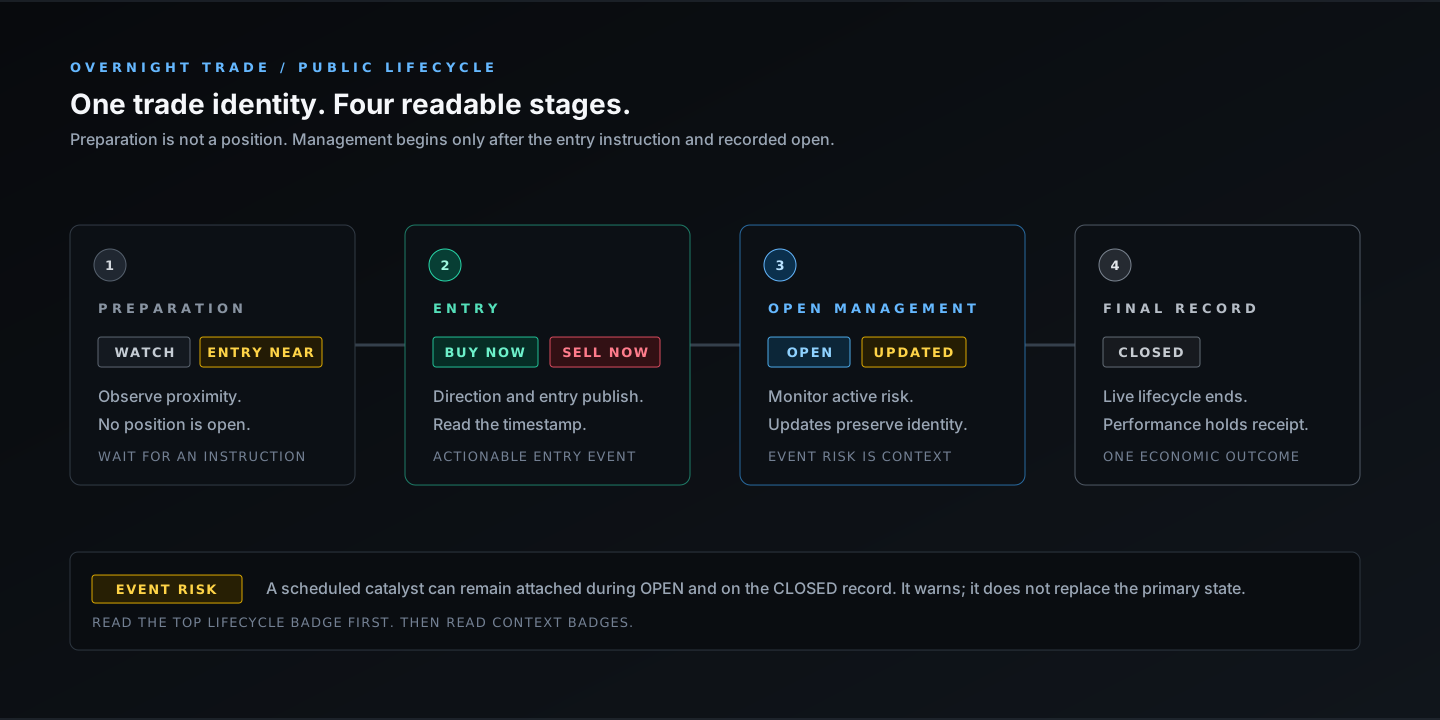
1WATCH and ENTRY NEAR are pre-trigger states. They can help you prepare, but there is no open position.
2BUY NOW or SELL NOW is the published entry instruction. Confirm side, price and time together.
3OPEN means a position record exists. UPDATED can tell you its active risk changed.
4CLOSED ends the live lifecycle. The final timestamped result belongs in Performance.
| Badge | Meaning | Your next check |
|---|---|---|
| WATCH | A setup is monitored but not actionable. | Wait for an entry instruction. |
| ENTRY NEAR | Price is close to a model entry. | Confirm distance and side; do not treat it as open. |
| BUY NOW / SELL NOW | The entry instruction is active. | Read the published entry and timestamp. |
| OPEN | The position has a recorded entry. | Monitor the current stop, live mark and latest event. |
| UPDATED / NEW STOP | A published field changed, often the current stop. | Inspect the warning, Alert Log and chart timestamp. |
| NEAR STOP | Price is close to the current stop. | Treat it as a warning, not a close; verify the live state. |
| EVENT RISK | A scheduled catalyst is attached. | Read the warning; the primary lifecycle remains authoritative. |
| CLOSED | The trade is no longer live. | Use Performance for the final receipt. |
Overnight Trade / Chapter 04
Your 60-second Overnight scan.
The workflow stays short because every deeper surface has a specific job: refresh, identify the newest state, read risk, then open evidence only where needed.
Open Overnight and press Refresh
Confirm session state, latest refresh time and the open/near summary before reading individual rows.
Start with BUY NOW and SELL NOW
These are fresh entry instructions. OPEN is active management; CLOSED is a retained receipt.
Confirm the OVERNIGHT badge
Native Overnight ownership is explicit. Do not infer product membership from the ticker or where else the card appears.
Read side, entry and current stop
This gives you direction, the fixed trade anchor and the latest published risk level.
Check horizon and context
Remember the typical 0.5–2 session window and read any UPDATED, NEAR STOP or EVENT RISK warning beneath the primary state.
Use the right evidence surface
Chart shows the selected record; Alert Log shows sequence; Performance resolves the close once.
Overnight Trade / Chapter 05
Use 0.5–2 sessions as a product guide, not a countdown.
Overnight may cross a session boundary, but the holding window is descriptive rather than guaranteed. The newest stop or close event always takes priority over the typical horizon.
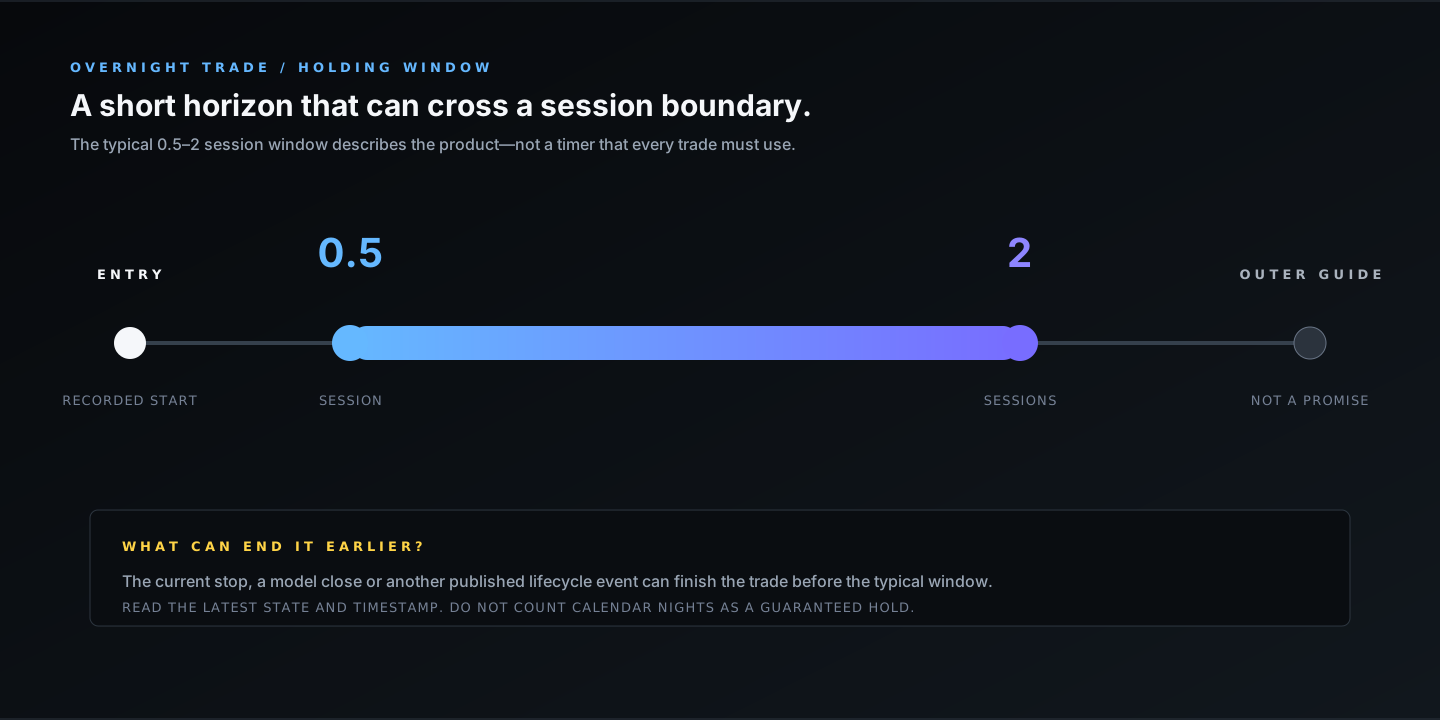
1The recorded entry starts the trade. Use its exact timestamp rather than estimating start time from candle width.
2Half a session describes the short end of the typical Overnight window; a valid trade can still close earlier.
3Two sessions describes the long end of the usual product window, not a promise or a minimum hold.
4A current stop, model close or other published lifecycle event can finish the record before the guide range ends.
Count market sessions, not calendar nights. A weekend or full market holiday changes elapsed calendar time without changing the product's market-session language.
Overnight Trade / Chapter 06
Treat SL as the current stop, not a permanent line.
Entry remains the published anchor. The current stop can change, so its value and update time must travel together. Overnight does not publish a fixed target.
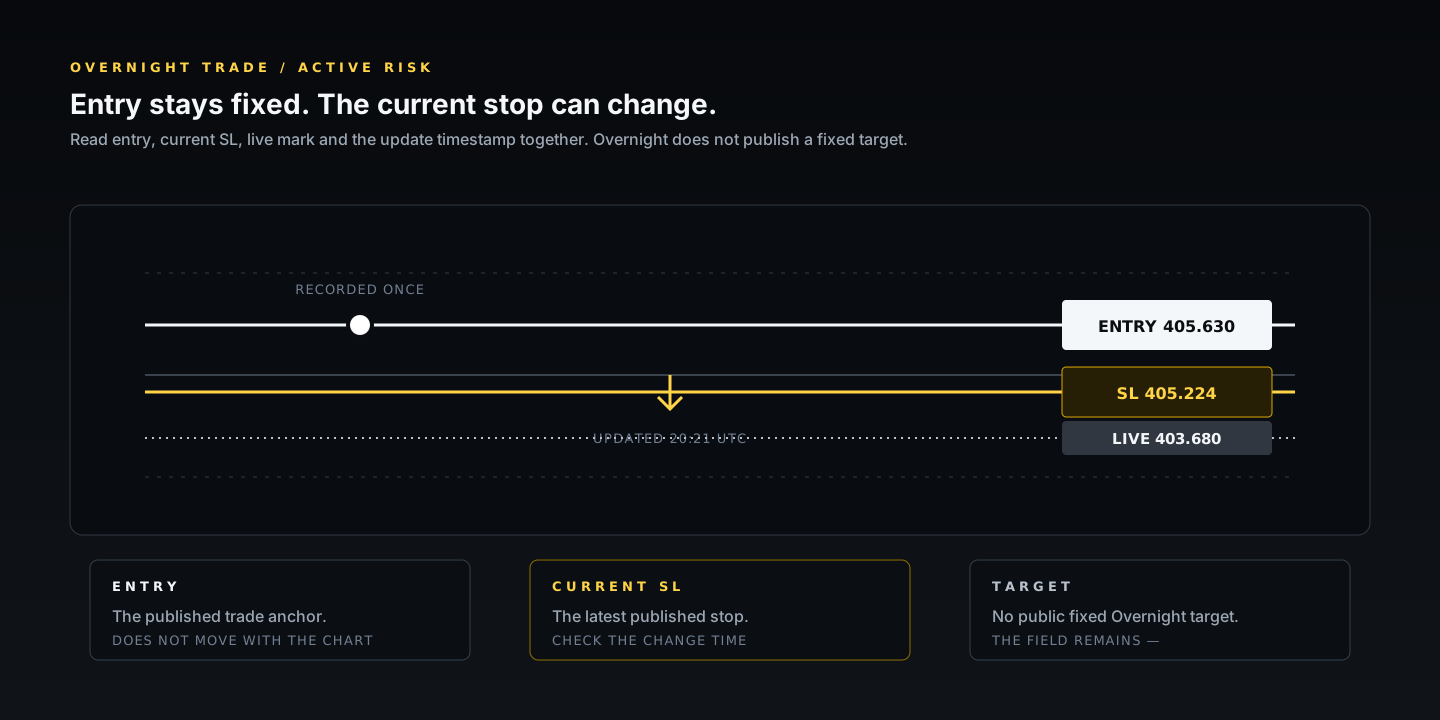
1Entry is recorded once and anchors the return. It does not slide to a more favorable later candle.
2SL is the current published stop. When it changes, the warning and update timestamp make that history visible.
3The live mark changes with the delayed reference feed. Read it with side before interpreting open P&L.
4Overnight does not publish a fixed take-profit. A dash in Target is intentional, not missing data.
When the stop changes, ask when. The Alert Log and chart should reveal the update time; an older screenshot is never proof of the current SL.
Overnight Trade / Chapter 07
Confirm every stop change at the top of the chart.
UPDATED or NEW STOP tells you that the risk record changed. It is not a second entry. The new value and timestamp belong together.
This real chart header shows the hierarchy clearly: recorded entry, current reference, open P&L, current stop and the exact time that stop was updated. The same structure applies when an Overnight-owned trade is also visible through Rapid.
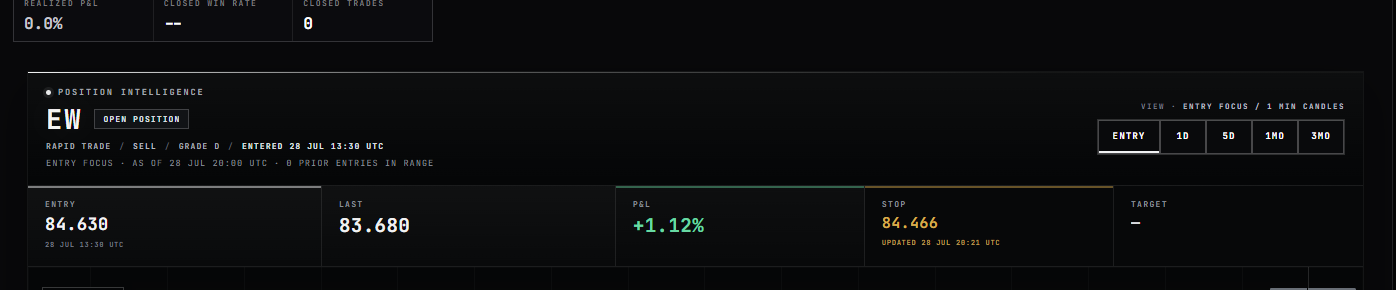
1OPEN POSITION confirms the lifecycle is still live. An update badge never replaces that primary state.
2ENTRY remains the original published anchor and keeps its own timestamp.
3Open P&L is derived from side, entry and the current reference. It is not the final Performance result.
4STOP shows the newest published level. UPDATED beneath it states exactly when the current value replaced the prior one.
5Changing Entry, 1D, 5D, 1M or 3M alters the visual window, never the selected trade or current stop.
Overnight Trade / Chapter 08
Read EVENT RISK as durable warning context.
The label identifies a scheduled catalyst recorded while the trade is active. It does not force a new instruction, replace the stop or guarantee a market reaction.
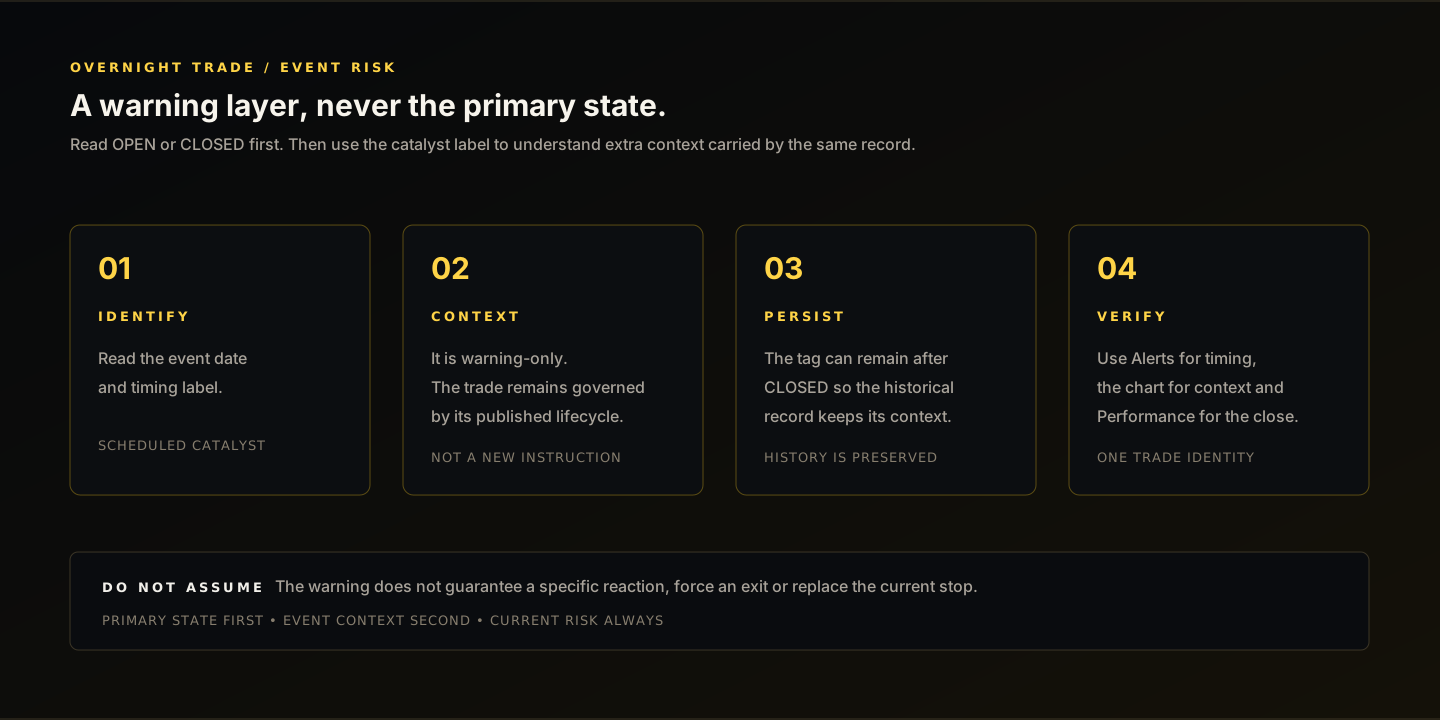
1Read the scheduled date and timing label so you know what catalyst the warning refers to.
2Warning-only means the existing OPEN, current stop and published lifecycle remain authoritative.
3EVENT RISK can remain after CLOSED because the final record should retain the context that existed while the trade was active.
4Use Alert Log for timing, the chart for price context and Performance for the final close receipt.
Primary state first, warning second. OPEN plus EVENT RISK is still open. CLOSED plus EVENT RISK is still closed.
Overnight Trade / Chapter 09
Follow strict newest-event chronology.
The native Overnight board sorts lifecycle events newest first. It does not use Rapid's positive-live visibility lift. WATCH and ENTRY NEAR remain in a separate bottom preparation partition.
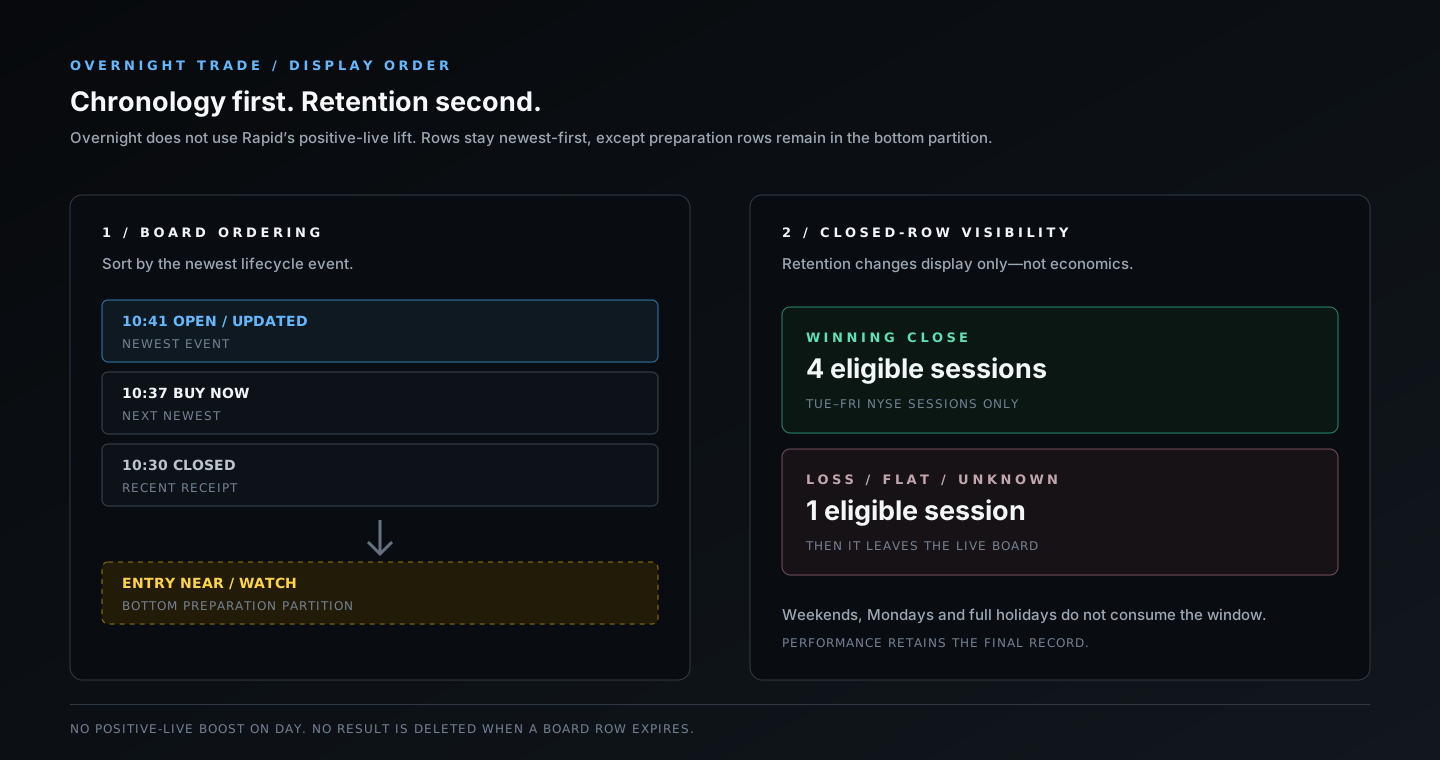
1OPEN, entry instructions, updates and recent closes sort by their newest lifecycle event.
2ENTRY NEAR and WATCH remain at the bottom because they are preparation, not active positions.
3Winning native Overnight closes can remain visible for four eligible Tuesday-through-Friday NYSE sessions.
4Loss, flat and unknown outcomes remain for one eligible session. Weekends, Mondays and full holidays do not consume either window.
Retention is display-only. When a closed row leaves the live board, its Performance record, timestamps and realized result remain intact.
Overnight Trade / Chapter 10
Keep Overnight ownership attached everywhere.
A native Overnight trade can also be distributed into Rapid for wider visibility. That does not create a second entry, exit, duration or P&L record.
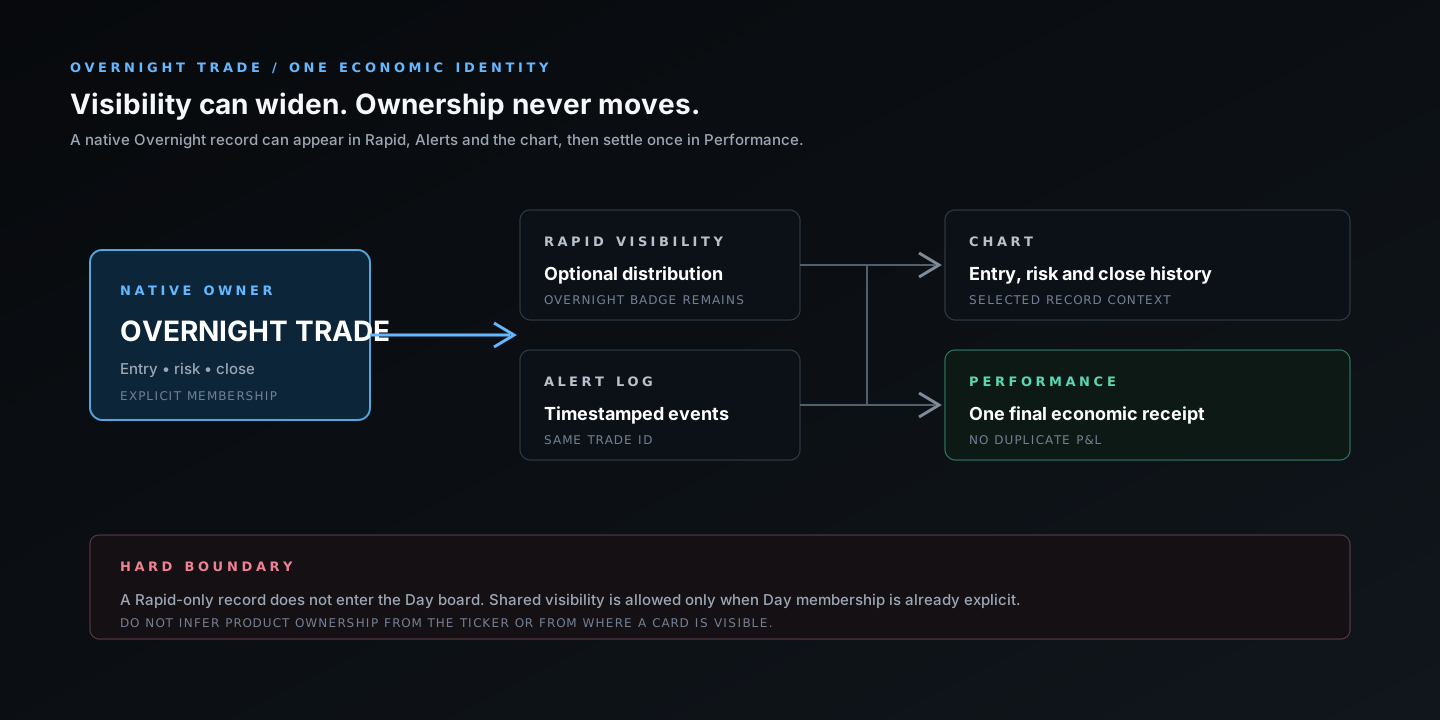
1OVERNIGHT is the native owner when membership is explicitly attached to the trade record.
2An eligible Overnight card can also appear on Rapid, but the OVERNIGHT badge and holding-window rules remain attached.
3Alert Log, chart and Performance resolve the same durable trade identity; only one final economic receipt exists.
4A Rapid-only trade never enters the Overnight board merely because the ticker is familiar or the horizon looks short.
Overnight Trade / Chapter 11
Use the chart as a timestamped trade record.
The expanded chart joins the selected card to its exact entry, active SL, live or final mark and any published level-change time.
This real EOG chart comes from a record that was distributed through Rapid while also appearing on Overnight. It shows why the headline comes before the candles: entry, P&L, current stop and timestamps stay visible above the plot, so changing range cannot detach the chart from the selected trade.
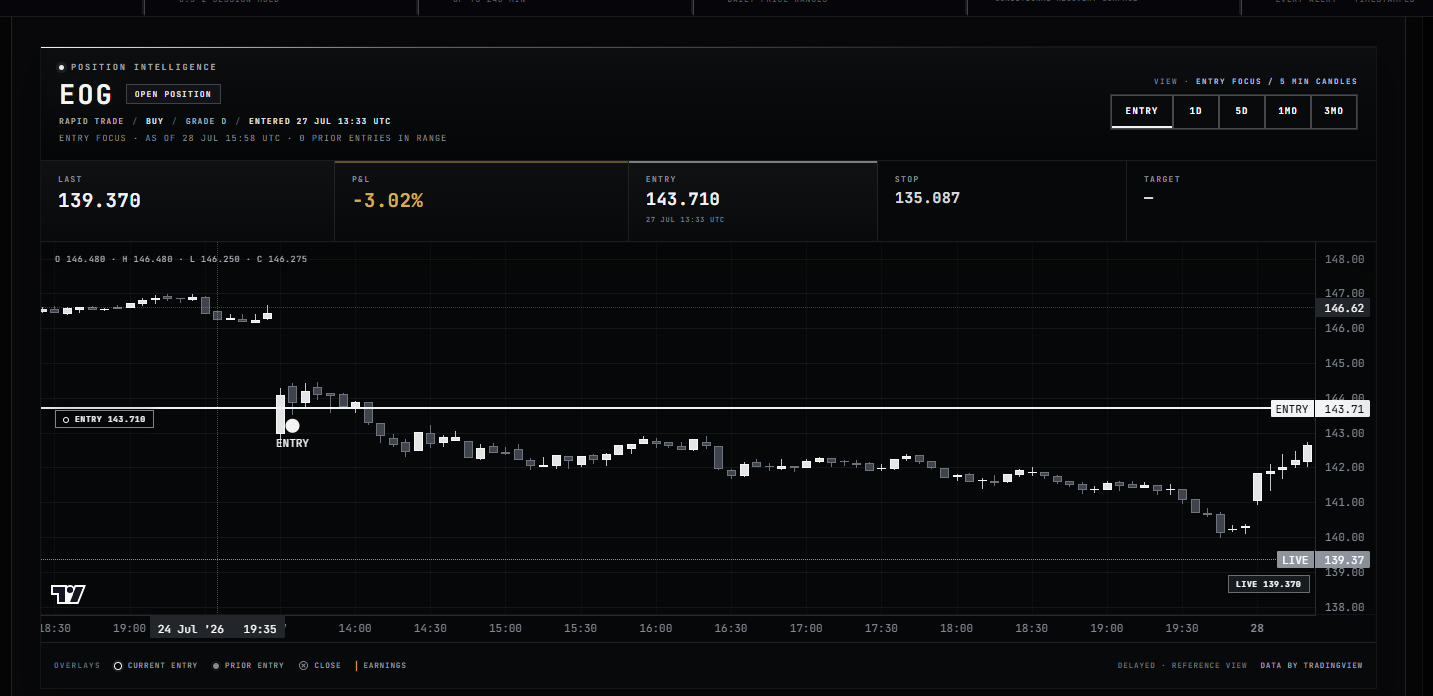
1The symbol, open-position state, side, grade and entered time establish the exact record before you read candle shape.
2Entry remains fixed and includes its timestamp. P&L and the live mark are shown separately.
3STOP is the current published risk level. When it changed, the update time appears beneath it.
4ENTRY focuses the event; 1D, 5D, 1M and 3M change visual range without changing the selected trade.
5The plotted ENTRY marker locates the published reference on its candle. It is not selected after viewing later price action.
Best use of the chart: answer one question at a time—when entry published, when risk changed, how price behaved around that time, or where the close recorded.
Overnight Trade / Chapter 12
Read Alert Log as a sequence of events.
The board tells you the newest state. Alert Log tells you what changed, when it changed and which product identity the event belongs to.
In this real Alert Log, ISRG, EOG and XOM publish Overnight OPEN events immediately after their entry instructions, while LULU, CVX and AXP show shared Rapid Trade · Overnight Trade visibility. One row represents one published event, not a second trade.
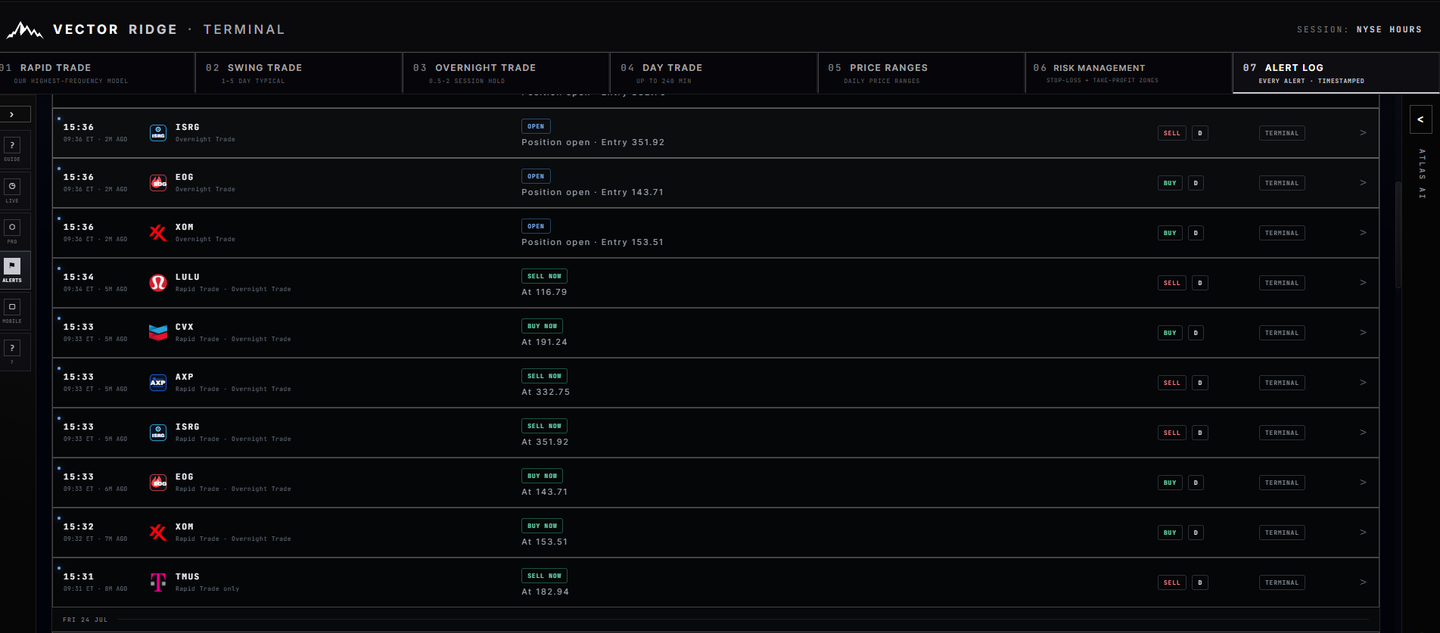
1Local time is paired with ET and an age so phone and Terminal events can be reconciled precisely.
2Rapid Trade and Overnight Trade together means shared distribution for one durable identity, not two entries.
3BUY NOW or SELL NOW says exactly what happened and prints the published entry reference beneath it.
4OPEN is a separate confirmation event. A refresh should not manufacture duplicate OPEN history for the same trade.
5The Terminal action opens the owning product and selected record so the alert can be reconciled against its current state.
A normal Overnight event sequence
BUY NOW or SELL NOW
Direction, entry reference and timestamp publish.
OPEN
The position receipt confirms an active recorded trade.
NEW STOP / UPDATED / NEAR STOP
The current risk context changes; the new event should say what changed rather than repeat the entry.
EVENT RISK
A scheduled catalyst is attached as warning-only context and can remain on the closed record.
CLOSED
The live lifecycle ends. The final alert should state the close, while Performance stores the expanded receipt.
Overnight Trade / Chapter 13
Verify the final trade in Performance.
Performance is the durable receipt: product tags, exact entry and exit, duration, realized result, close reason and the supporting chart.
What Performance settles
Published start
Price, side, grade and timestamp are attached to the same durable trade identity.
Exact duration
The hold is calculated from the recorded timestamps, not estimated from the chart width.
Published finish
Exit price, time and reason are grouped together and remain after the live row expires.
One realized result
Shared Overnight/Rapid visibility never creates a second economic outcome.
Expanded-record checklist
| Check | What should agree | Why it matters |
|---|---|---|
| Product tags | OVERNIGHT appears when the native product owns the lifecycle; RAPID can appear beside it when distributed. | Multiple tags still resolve to one economic record. |
| Entry | Side, price and exact entry time match the original alert and chart marker. | The start cannot be reconstructed from a later favorable candle. |
| Exit | Final price, exact exit time and close reason belong to the same receipt. | A CLOSED alert is the event; Performance is the durable expanded record. |
| Duration | Time held is calculated from the two recorded timestamps. | Do not infer the hold from the typical 0.5–2 session label. |
| Event risk | Any warning recorded while active can remain visible after close. | Historical context should not disappear when the lifecycle ends. |
One identity means one result. If the same native Overnight setup also appeared in Rapid, Performance should show one entry, one exit, one duration and one realized P&L record.
Overnight Trade / Chapter 14
Carry the same reading order into the mobile app.
Mobile compresses the table into cards, but product selection, primary state, side, grade, entry, SL, live or closed price, P&L and chart remain intact.
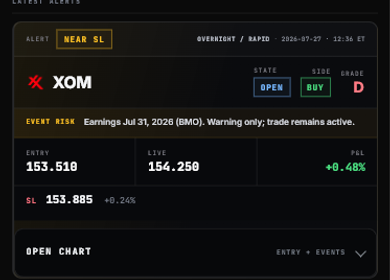
1NEAR SL warns that price is close to the current stop. It does not say the trade is closed.
2OVERNIGHT / RAPID means one native Overnight record is visible in both eligible products.
3Open Chart expands the selected trade without changing its product or identity.
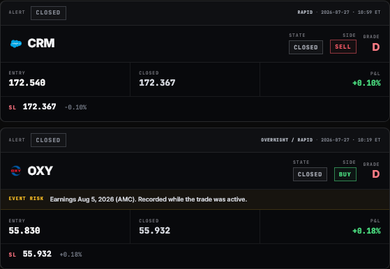
1CLOSED at the top tells you the live lifecycle ended before you inspect final price or return.
2OVERNIGHT / RAPID preserves the shared product context without duplicating the result.
3EVENT RISK remains because the catalyst context was recorded while the trade was active.
Phone workflow
Select Overnight Trade
Use the product selector to isolate native Overnight cards before reading a state.
Read the top event or state first
This tells you what changed before you inspect prices or P&L.
Open chart for the exact record
The drawer should remain open while you inspect Entry, 1D, 5D, 1M or 3M.
Open Alerts for chronology
Entering Alerts requests fresh data so the newest published event can appear first; delivery is not a promise of zero latency.
Overnight Trade / Chapter 15
Use the right authority for every question.
The live board, Alert Log, chart and Performance are complementary. Reliability comes from asking each surface the question it was built to answer.
Current Overnight card
Authority for primary state, side, entry, current stop, live mark and open P&L.
Alert Log
Authority for the timestamped sequence of entry, risk changes, warnings and close.
Chart
Authority for the visual history attached to the selected trade and its timestamps.
Performance
Authority for closed entry, exit, duration, reason and realized result.
Common questions
Does ENTRY NEAR mean an Overnight position is open?
No. It is a preparation state. Wait for BUY NOW or SELL NOW and the recorded OPEN lifecycle.
Does Overnight always remain open for 0.5–2 sessions?
No. That is the typical product window. An earlier stop, model close or other published lifecycle event can finish the trade first.
Why did the SL change?
The row shows the current published stop. Use its warning, chart and Alert Log to see when the level changed.
Where is the Overnight target?
Overnight does not publish a fixed target. A dash in the Target field is intentional.
Why can the same Overnight trade appear in Rapid?
Eligible Overnight records can be distributed into Rapid for visibility. OVERNIGHT ownership remains attached and Performance records the economics once.
Why did a recent close disappear from the live board?
Closed-row retention is display-only. Winning closes can remain for four eligible Tuesday-through-Friday NYSE sessions; loss, flat and unknown outcomes remain for one. Performance keeps the final record.
Why is a positive live Overnight trade not automatically at the top?
Overnight uses strict newest-event-first chronology. The positive-live visibility lift belongs to Rapid, not the native Overnight board.
Does EVENT RISK mean the position will close?
No. It is warning-only context. OPEN, the current stop and later lifecycle events remain authoritative, and the warning can remain visible after CLOSED.
Does NEAR STOP mean the trade is already closed?
No. It means price is close to the current stop. Wait for the primary state or a specific close event before treating the lifecycle as finished.
What if the expanded chart looks narrow or partly blank?
Collapse and reopen it, then choose Entry. The chart resynchronizes after the row reaches full width while preserving valid manual zoom and pan.
Ready
Open Overnight Trade with state, horizon and current stop aligned.
Start with the newest public state, confirm the OVERNIGHT badge, read the current stop and use Alert Log, chart and Performance for the evidence behind the row.