Product guide · Data Vault
FIND THE HISTORY. DEFINE THE EVIDENCE.
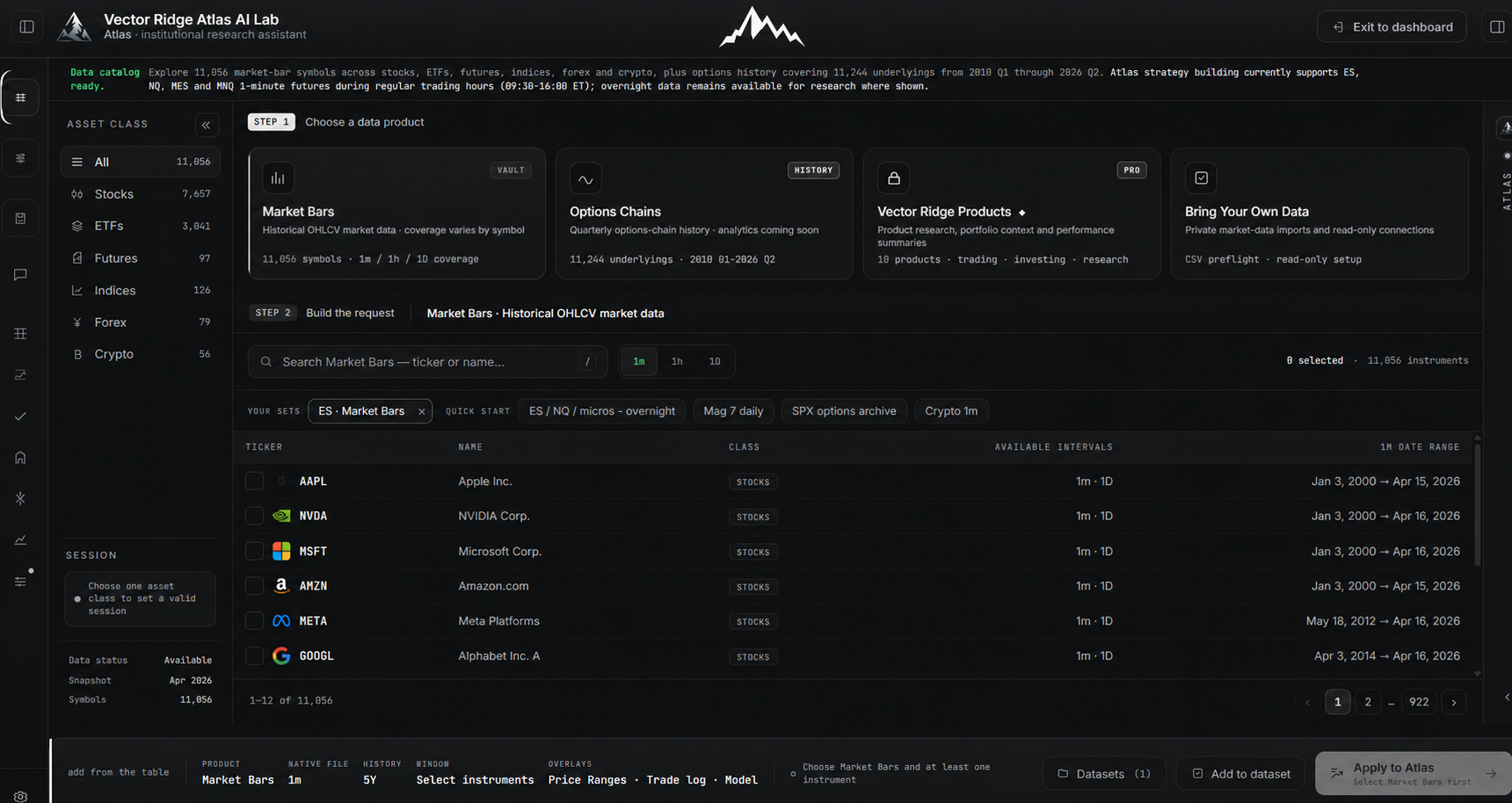
Data Vault is the historical-data catalog and handoff layer for Vector Ridge research. It helps you find available market bars or options history, define a precise slice and pass a source-bound research contract into supported Atlas AI workflows.
The short answer
WHAT IS DATA VAULT?
Data Vault is not a live signal feed and it is not the Atlas AI model. It is the catalog that tells a research workflow what historical source exists, which symbols and native intervals are represented, what date coverage is advertised and what must be confirmed before computation.
A useful historical test begins with a bounded data contract: source, asset, symbol, interval, start and end dates, timezone, session and any known coverage limitations. Data Vault makes those choices explicit so the research question does not quietly expand or change after the result is seen.
When you select Apply to Atlas AI, the handoff carries dataset identity and prerequisites. Raw protected market bars are not pasted into an AI conversation. Atlas receives the reference it needs to plan a supported deterministic run.
Catalog snapshot
WHAT DATA IS COVERED?
Coverage varies by symbol and source. The numbers below describe the current public catalog snapshot, not a guarantee that every market has every interval or that every Atlas tool supports every row.
| Dataset | Public coverage | Typical use | Confirm before research |
|---|---|---|---|
| Market bars | Stocks, ETFs, futures, indices, forex and crypto; catalog history reaches back to 2000 where available. | Price behaviour, strategy testing, event windows and regime analysis. | Exact symbol, native interval, first/last observation, gaps and adjustments. |
| Options history | Quarterly chain-history catalog from 2010 Q1 through 2026 Q2 in the current snapshot. | Volatility, skew, term structure and event-related research. | Underlying identity, expiration coverage, field availability and tool support. |
| Atlas-ready futures | Approved one-minute ES, NQ, MES and MNQ research slices for supported templates. | Typed opening-range and three-candle FVG workflows during the documented beta. | Date range, America/New_York time contract, RTH interpretation and strategy executor. |
| Trade-log uploads | User-provided structured trade records, subject to column validation. | Performance, regime, distribution, risk and process analysis. | Schema, timestamps, side, quantity, prices, costs and missing values. |
Five explicit choices
FROM CATALOG TO RESEARCH CONTRACT.
The interface should reduce ambiguity before compute. Make the data choices first; let Atlas ask about the strategy second; inspect the receipt last.
Choose the dataset family
Select Market Bars, options history or a validated trade log according to the question you are actually asking.
Choose one bounded market
Define the asset class and exact symbol or contract. Avoid silently combining instruments with different sessions or roll behaviour.
Lock interval and dates
Use an inventory-backed native interval and a defensible start/end window. More history is not automatically better evidence.
Declare timezone and session
RTH, ETH and custom sessions produce different bars and trades. “Regular” must never remain implicit.
Apply the selection to Atlas
Send the dataset reference and prerequisites into the research thread. Atlas should confirm the contract before planning any test.
Use a supported deterministic tool
An idea can remain a draft. Metrics appear only when an approved executor completes and returns a receipt.
Keep source and result together
Preserve the dataset reference, strategy specification, costs, validation settings, output and parent-child version lineage.
Atlas AI handoff
METADATA MOVES. PROTECTED BARS STAY PROTECTED.
Atlas needs enough information to understand and route the research request, but it does not need a raw dump of protected historical bars inside the conversation. The handoff can identify the source, symbol, interval, coverage, timezone and session while deterministic infrastructure accesses the approved data separately.
This separation matters for two reasons. First, it preserves data controls. Second, it keeps empirical claims tied to the actual tool that computed them. Atlas can explain a run, challenge its assumptions and propose the next test; the run receipt owns the numbers.
Read the Atlas AI walkthrough →Research boundaries
WHAT THE CATALOG PROVES—AND WHAT IT DOES NOT.
Search results can overstate a data product by treating inventory, executable support and verified research as the same thing. Data Vault keeps them separate.
DATA VAULT CAN ESTABLISH
- A catalogued source and dataset family.
- The symbol, interval and advertised date coverage.
- The required timezone, session and handoff prerequisites.
- Whether a defined selection can be proposed to a supported research workflow.
DATA VAULT CANNOT ESTABLISH
- That every catalogued row is complete, gap-free or adjusted identically.
- That every Atlas executor supports every symbol, interval or idea.
- That a historical result will persist live or survive costs and regime change.
- That an AI explanation can substitute for a completed deterministic receipt.
Data Vault FAQ
COMMON DATA QUESTIONS.
For current inventory, open the live catalog. For current plan access, use the Products page. This guide explains the durable research contract rather than freezing commercial details.
Is Data Vault a real-time market-data terminal?
No. Data Vault is a historical research catalog and handoff workspace. Live signal state and current reference prices belong in the Trading Terminal.
Does catalog presence guarantee Atlas support?
No. Catalog presence proves inventory, not executor compatibility. Confirm the symbol, interval, dates, session and supported strategy template before running.
Why do timezone and session matter?
The same market can produce different bars, ranges and trades under RTH, ETH or custom sessions. A deterministic result needs an explicit time contract.
Can Atlas AI see all raw historical bars?
The intended handoff sends metadata and research prerequisites. Protected data remains behind controlled deterministic tools rather than being pasted into the chat.
What makes a backtest result trustworthy?
A source-bound specification, realistic costs, chronological handling, holdout evidence, integrity checks and a completed receipt. No single metric is enough.
Where can I see current Data Vault access?
Check the Products page. Access, trial eligibility and pricing may change, so this guide does not hardcode them.